THE HIDDEN COST OF LOST HELMETS: HOW MUCH YOUR PROGRAM IS REALLY LOSING
If you’ve coached long enough, you know there are two things that disappear faster than your weekend: helmets and practice jerseys.
You swear you counted the helmets twice in August. You swear everyone turned theirs in. And yet every offseason, the math doesn’t math. A few helmets vanish. A couple sit in trunks all winter. One or two get “borrowed” for padded camps. And the freshman kid who quit in Week 3 somehow takes his home as a parting gift.
It’s normal… but it’s also expensive. And most programs have no idea how much money they’re bleeding every year because of simple, preventable loss.
So let’s talk numbers, reality, and what coaches can actually do about it.
WHAT A HELMET REALLY COSTS IN 2025
Helmets aren’t cheap. You already know that. But most coaches underestimate how expensive that one missing helmet really is.
Real-world pricing right now:
Riddell SpeedFlex: around $500 each
Schutt F7 & Air XP: generally $340–$470
Teams who fully outfit a player with all equipment: budget $500–$600 per athlete
That’s just one kid. If you run a roster of 70–90 players? Do the math.
When helmets disappear in bulk, the damage is massive:
One high school had 44 helmets stolen = roughly $20,000 in losses.
Another reported that missing helmets threatened whether they could even play the season because the district couldn’t replace them fast enough.
That’s the kind of hit that destroys budgets. Or kills a reconditioning cycle. Or forces an AD to take money from another sport to cover your shortfall.
WHERE HELMETS ACTUALLY GO MISSING
Here’s the part nobody talks about: most missing helmets aren’t stolen. They’re lost because your systems break down at the lower levels.
Varsity kids tend to baby their gear. They get it. They’re protective of their stuff.
JV and freshman? Different story.
They’re the ones who:
Leave helmets in Mom’s SUV
Forget them in the locker room for three days
Swap with a buddy and forget whose is whose
Quit the team and never return anything
Take “loaner” helmets and never get logged into your spreadsheet
If your program loses 3–5 helmets a year, you’re actually right on track with what most coaches privately admit.
The problem is…
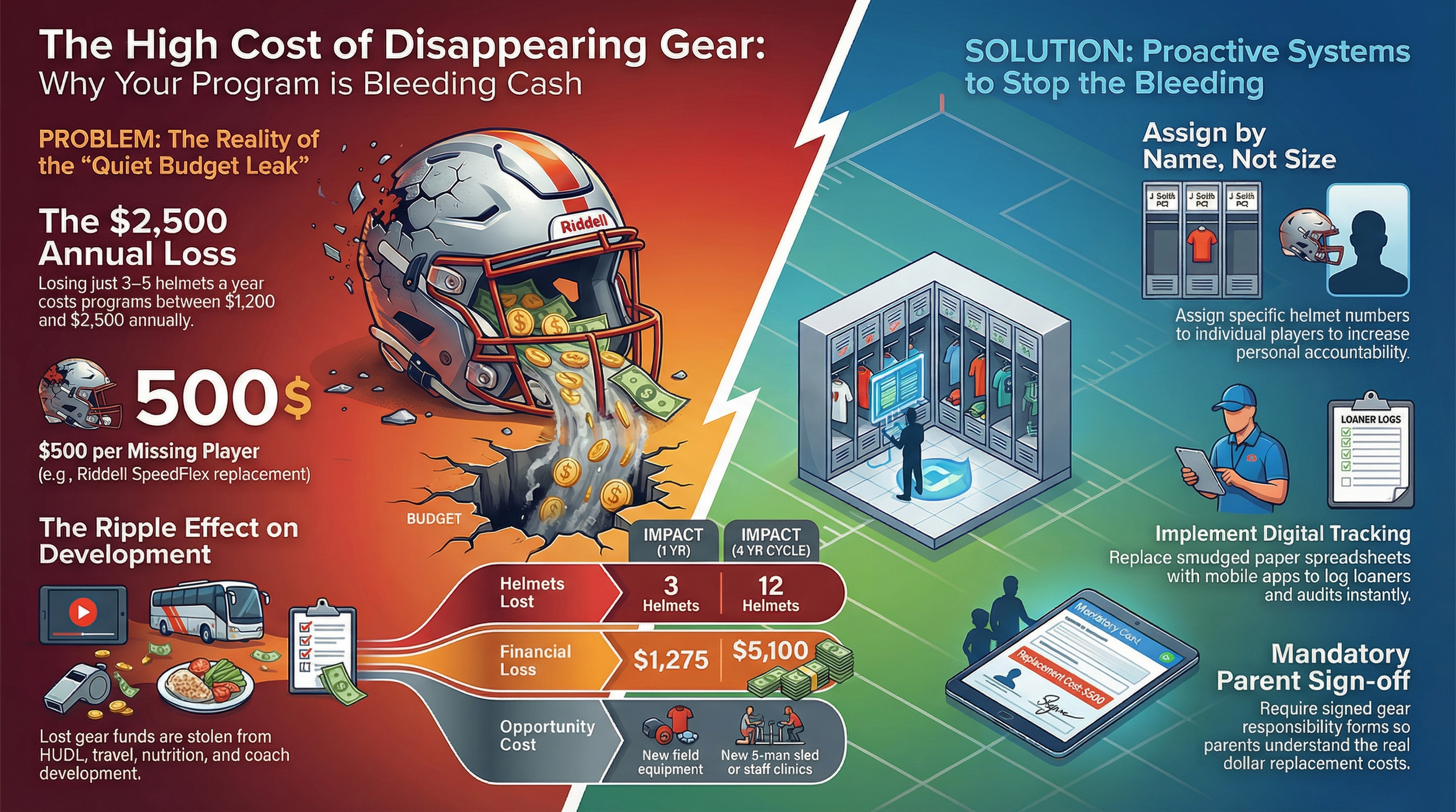
3–5 helmets a year = $1,200–$2,500 in losses. Every. Single. Year.
And that’s just from helmets, not additional gear.
THE HIDDEN COSTS BEYOND THE PRICE TAG
It’s not just the replacement cost. There are ripple effects:
1. Your reconditioning cycle gets wrecked.
Helmets aren’t bought one-by-one, they’re bought in cycles. Lose a few? Suddenly your cycle is off rhythm and you’re forced to buy more new ones than planned.
2. It wastes hours of your time.
Nothing is more brutal than hunting for gear:
Digging through lockers
Cross-checking spreadsheets
Calling parents
Guessing who had #72 because your paper sheet is smudged from sweat and dirt
That time adds up.
3. It creates safety issues.
If you don’t have enough certified helmets on hand, you can’t legally put kids on the field. Coaches have had seasons delayed because of this. No exaggeration.
4. It drains money you could’ve spent elsewhere.
Lost helmets =
fewer dollars for HUDL
fewer dollars for meals
fewer dollars for new jerseys
fewer dollars for a new drone
less budget for travel, nutrition, and development
Money is zero-sum in high school athletics.
A QUICK REAL-WORLD EXAMPLE
Take a typical program:
70 total helmets
Lose 3 per year
Replacement cost: roughly $425
Annual loss: $1,275
Four-year cycle: $5,100
That’s a new five-man sled
That’s clinics and development for your staff.
Gone because three helmets walked out the door every year.
HOW TO STOP LOSING HELMETS (WITHOUT WORKING HARDER)
Here’s the good news: most gear loss isn’t about laziness, it’s about the system being broken. Fix the system, and you fix the problem.
Here’s what every coach can do:
1. Assign helmets to individual kids, not sizes.
“Large 14” means nothing.
“Helmet #114 – Assigned to Marcus Young” means everything.
2. Make parents sign a gear responsibility form.
When they see the real dollar amount, accountability skyrockets.
3. Audit gear three times a year.
Start of season
Mid-season
Turn-in week
Small checks save huge headaches.
4. Treat JV and freshman like varsity.
The younger the player, the more structure they need.
5. Track loaners the second they go out.
Loaners are the #1 way helmets disappear.
WHAT DIGITAL TRACKING DOES THAT A CLIPBOARD CAN’T
Not a sales pitch, just the truth.
Digital tracking doesn’t make coaching easier. It makes managing the chaos easier.
With a sports equipment tracking app, you can:
Check out gear from your phone in the actual equipment room
See which kid has which helmet instantly
Track all levels (V/JV/Freshman) without 10 spreadsheets
Get alerts on overdue items
Pull reports before equipment turn-in so nothing blindsides you
Instead of staying up late filling in Excel, you log it once and move on.
Coaches don’t need more work.
They need fewer unknowns.
BOTTOM LINE
Lost helmets aren’t “part of the job.”
They’re a quiet budget leak causing hundreds or thousands of dollars a year to disappear because you’re juggling 100 tasks at once.
The reality:
Helmets cost real money
Younger players lose them most
Systems, not people, cause most losses
And fixing the system saves time, money, and stress
Your program deserves better than locked-in-the-equipment-room spreadsheets and random gear hunts.
You can control this.
And you can start today.
We built Sideline HQ because we lived this life. Long nights in the equipment room, mismatched numbers on spreadsheets, and that one kid who swears he turned his helmet in.
If you want the chaos off your plate, we have you covered.